Raktabija Suras on Bengaluru Roads
The potholes on Bengaluru’s roads are famous—though for all the wrong reasons. Hardly a day passes without them making the news. Successive deadlines have been announced by the Karnataka government to make the roads pothole-free, yet the potholes remain, stubborn as ever.
Whenever I see one of these craters on the road, I am reminded of a story my grandmother used to tell.
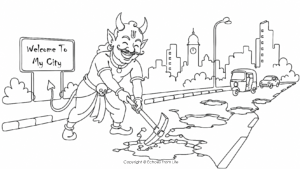
It is the story of a demon called Raktabija Sura.
Like many demons in Indian mythology, Raktabija performed severe penance to obtain a boon from Lord Shiva. His ultimate goal was immortality. The gods, however, were never willing to grant outright immortality to their eternal adversaries. So demons often sought clever alternatives—boons that made death nearly impossible.
One demon, for example, asked that he could be killed only by a child born of Lord Shiva and Lord Vishnu, a condition that appeared impossible. Naturally, the gods eventually found a way around it. Such stories are common in mythology.
Raktabija chose a different path.
Instead of asking for protection from death, he asked for a boon that would ensure his continued existence. Lord Shiva granted him a remarkable gift: every time a drop of Raktabija’s blood touched the ground, another Raktabija would be born at that very spot. Rakta means blood, and bija means seed.
Now consider the consequences.
Demons and gods were perpetually at war. If a god wounded Raktabija and his blood fell to the earth, each drop would create a new Raktabija. If those newly created demons were struck and bled, even more would emerge. One became many; many became countless. It was a self-perpetuating chain reaction with no obvious end.
In effect, Raktabija had found a way to make his lineage immortal. Every drop of spilled blood became the seed of another clone.
Bengaluru’s potholes seem to possess the same boon.
Close one pothole, and another appears. Repair a stretch of road, and before long a fresh set of craters emerges elsewhere. They seem to multiply with a determination that would have impressed even Raktabija himself.
Of course, these potholes have not received any divine blessing from Lord Shiva. Their persistence is the result of something far more earthly: poor-quality road construction and a chronic lack of coordination among government departments.
In fact, the coordination is so perfect that utility departments often arrive to dig up a road shortly after it has been freshly laid. Whether it is electricity, water supply, drainage, or telecommunications, someone invariably finds a reason to cut through new asphalt. Whatever can be done to shorten the life of a road is done with remarkable efficiency.
The only people who seem to benefit from this cycle are the contractors who receive contracts to repair potholes and the politicians who award those contracts. One depends on the other. A permanently solved problem benefits neither. The longer the potholes survive, the longer the contracts—and the opportunities—continue.
Which raises an interesting question: Who is the real Raktabija Sura of Bengaluru’s roads?