I Am Intolerant. And I’m Not Sorry About It.
In today’s climate, that statement is enough to invite assumptions. It sounds like the declaration of someone unwilling to listen, unwilling to engage, unwilling to accept differences. The word itself has become synonymous with prejudice, authoritarianism, and closed-mindedness.
But before we condemn intolerance outright, perhaps we should ask a different question: Why should I not be intolerant?

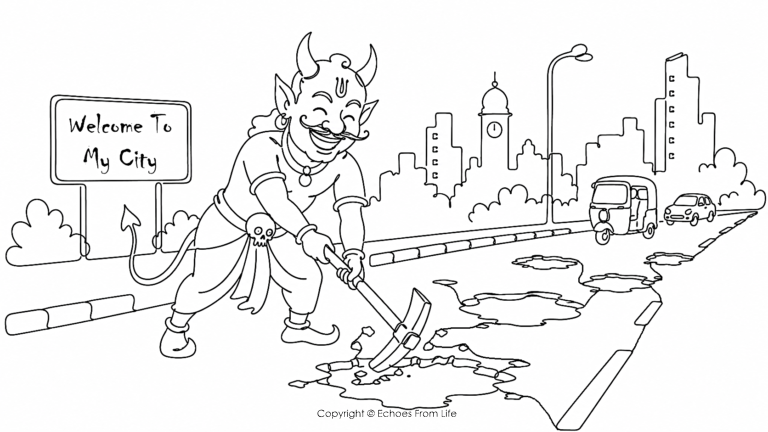
Every working day, I spend about ninety minutes travelling to my office and nearly the same amount of time returning home. That is three hours a day on the road. Over a year, that adds up to almost eight hundred hours—more than thirty days of my life spent navigating traffic!
The absurdity is not the distance. My commute is barely nine kilometres each way.
The problem is everything else: Broken roads. Endless bottlenecks. Poor planning. Indifference masquerading as governance. On some stretches, calling them roads feels generous. They are little more than scars across the landscape, patched and neglected in equal measure. Yet these are the very roads that thousands of citizens depend upon every day to get to work, school, hospitals, and home.
- Should I not be intolerant of a system that repeatedly fails at providing the most basic public infrastructure?
- Should I not be intolerant of those entrusted with public office who treat accountability as an inconvenience rather than an obligation?
Democracy is often celebrated for giving people a voice. Less frequently discussed is the responsibility that comes with exercising power on behalf of others.
What should one make of a political culture where family lineage often outweighs competence? Where positions of influence are inherited rather than earned? Where public office is treated less as a public trust and more as a family asset?
My objection is not to an individual’s background, education, or personal circumstances. It is to the assumption that proximity to power qualifies someone for power.
- Shouldn’t citizens be intolerant of nepotism?
- Shouldn’t we be intolerant when institutions reward loyalty over merit?
- Shouldn’t we be intolerant when public interest becomes secondary to political convenience?
And yet, whenever dissatisfaction is expressed, the conversation quickly shifts. The focus moves away from the issue itself and towards the person raising it.
Opinion matters. Dissent matters. But what matters even more is how society reacts to dissent.
A differing opinion is not a threat. It is not rebellion. It is not disloyalty. Yet public discourse increasingly treats disagreement as something to be defeated rather than understood. Too often, criticism is met not with counterarguments but with labels. Questioning a policy becomes questioning the nation. Challenging a leader becomes challenging the legitimacy of the system itself. The objective is no longer to engage with an argument but to discredit the person making it.
The irony is that democracy depends on precisely the thing we seem least willing to tolerate: disagreement. A society does not reveal its character through unanimity. It reveals its character through its response to dissent. When someone expresses an uncomfortable opinion, the true test is not whether we agree with them. The true test is whether we allow space for that opinion to exist.
Every opinion creates an opportunity. We can either respond with reason or react with outrage.
The former strengthens society. The latter weakens it.
Progress has always depended on people willing to disagree. The dissenter is not necessarily the problem. Sometimes, the inability to tolerate dissent is.
That is why I remain unapologetically intolerant—though perhaps not in the way the word is usually understood.
- I am intolerant of incompetence presented as governance.
- I am intolerant of entitlement presented as leadership.
- I am intolerant of nepotism presented as democracy.
- I am intolerant of the casual disregard for public responsibility.
- And I am intolerant of the belief that disagreement itself is a threat.
What I am not intolerant of is difference.
A healthy society does not require uniformity of thought. It requires the confidence to accommodate competing views without fear. There is a profound difference between being intolerant of people and being intolerant of ideas, behaviours, and systems that fail the public trust.
The first diminishes society. The second may be what keeps it honest.
So, why am I intolerant? Because some things deserve acceptance. And some things deserve resistance.