Veni, Vidi, Vici — Language and the Quiet Rise of Cultural Hegemony
“I came, I saw, I conquered.”
The phrase, attributed to Julius Caesar after a swift military victory, captures the essence of conquest. When one ruler defeats another, political control changes hands. The new authority is accepted, willingly or otherwise, and a new order emerges.
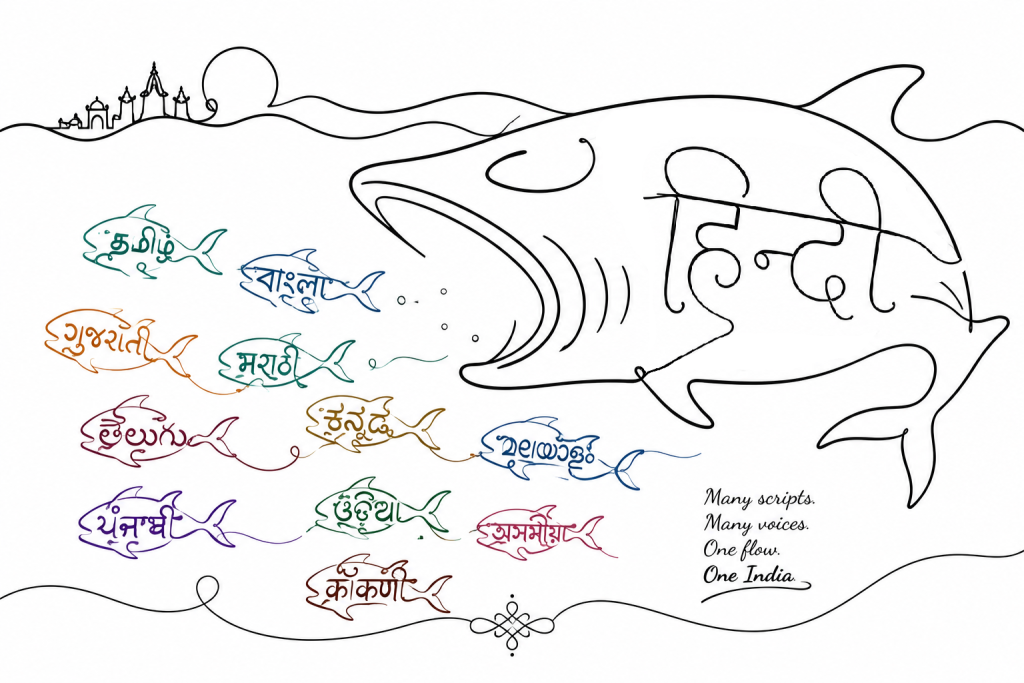
But what happens in a cultural conflict? Can a language become dominant in the same way an empire does? Can cultural influence become so pervasive that people gradually adapt without even realizing it?
Bengaluru offers an interesting example.
For much of the twentieth century, Kannada and Tamil were the languages commonly heard on the city’s streets. This was hardly surprising. Kannada was the language of the state, while large numbers of workers from neighbouring Tamil Nadu had settled in the city over generations. Historical ties between the regions had also encouraged cultural exchange.
People adapted naturally. Many Kannada speakers learned enough Tamil to communicate with workers and traders. Likewise, many Tamil speakers learned Kannada to integrate into local society. The relationship was mutually beneficial. Neither community expected the other to abandon its linguistic identity. Instead, accommodation emerged through necessity and respect.
The twenty-first century brought a different dynamic.
As Bengaluru established itself as India’s technology capital, economic growth created an enormous demand for skilled workers. The local talent pool could no longer meet the requirements of a rapidly expanding industry. Professionals from across India moved to the city in large numbers, many of them from Hindi-speaking regions.
This migration transformed the city’s linguistic landscape.
Most newcomers did not know Kannada, so they naturally communicated in Hindi. Equally naturally, many locals responded in Hindi to facilitate everyday interactions. What began as a practical solution gradually became a habit.
Habits matter.
A language used repeatedly in markets, apartments, restaurants, and public spaces slowly acquires social power. Over time, Hindi began appearing not only on the streets but also in workplaces and professional settings. In many offices, speaking Hindi became the easiest way to participate in group conversations.
The challenge arises when convenience starts becoming expectation.
People who are not comfortable speaking Hindi often find themselves adjusting to the majority language to avoid feeling excluded. The pressure is rarely explicit. No one may demand conformity. Yet the desire to belong is a powerful human instinct. Gradually, individuals alter their linguistic behaviour to fit into the dominant social environment.
This is why language debates evoke strong emotions.
Language is not merely a tool for communication. It carries memories, traditions, literature, humour, and ways of understanding the world. Every language represents a distinct cultural experience. When one language becomes overwhelmingly dominant, many people fear that their own cultural space is shrinking.
That is why language policy must be approached with sensitivity.
The challenge with language policy is that what appears voluntary on paper often becomes compulsory in practice.
Consider the recent debate in Maharashtra, where Hindi has been designated as the default third language, while students theoretically retain the option to choose another language. At first glance, that appears to be a reasonable compromise. But public policy cannot be evaluated merely by what is written in government notifications; it must also be judged by how it operates.
How practical is it for a school with a class strength of thirty or thirty-five students to recruit multiple language teachers for a handful of students opting for different languages? In a government school, what mechanism even exists to record, aggregate, and act upon the language preferences of individual students? In most cases, there is none. The path of least resistance is obvious: students are simply assigned Hindi because it is the language already available within the system.
A choice that cannot realistically be exercised is not much of a choice at all.
The same pattern is visible beyond education. Increasingly, private service providers narrow the range of linguistic options available to consumers and then present the resulting situation as a matter of convenience.
I noticed this while watching FIFA World Cup highlights on Jio. The broadcast began in English, only to switch automatically to Hindi moments later, without any prompt and without any obvious setting to revert to English commentary. Similar experiences are common across channels. Even international content providers such as BBC are frequently presented through a Hindi-first lens.
None of these examples, taken individually, may seem significant. But together they reveal a broader trend. A language does not become dominant only through official decrees. It becomes dominant when institutions, businesses, and public systems repeatedly assume it to be the default choice.
This is why people object.
The issue is not Hindi itself. The issue is the growing tendency to treat it as first among equals. The objection is to the growing assumption that everyone else should adapt to it. A feeling of being told, repeatedly and subtly, that one culture’s comfort matters more than another’s. Ultimately, this is not an argument against a language.
It is an argument against cultural indifference.
Languages are not meant to conquer one another. The moment we begin treating one language as the natural heir to every space, we risk turning cultural exchange into cultural conquest.
Veni. Vidi. Vici. — by decree, by habit.